Most cars, SUVs, minivans
Passenger tires, up to 21″
$29.99
New tires.
On the road in an hour.
Bramalea Tire mounts, balances and installs new tires the same day at 2020 Clark Blvd, Brampton. Installation starts at $29.99 per tire, and a set of four takes about 45 to 60 minutes.
4.5 ★ from 500+ Google reviews · In Brampton since 1990
Pricing
Bigger, stiffer tires take more labour and equipment to mount safely. Per tire, before HST.
What’s included
After you drive away
Even a correctly torqued wheel can loosen from things no one controls: heat from braking, temperature swings, worn studs or nuts, potholes and curbs.
Balanced, torqued and set to spec.
Mould coating on new tread means a little less grip at first.
A quick check that every nut is still at spec.
Buy here, drive away
Pick your tires online, by phone or at the counter. We confirm your size, book your install and have you back on the road in about an hour.
Installation starts at $29.99 per tire for standard passenger tires up to 21 inches.
Larger wheels, light truck tires, run-flat tires and some specialty applications cost more because they require additional labour and equipment.
A typical set of four passenger tires takes about 45 to 60 minutes once the vehicle is being worked on.
Larger wheels, run-flats, corrosion, TPMS issues or specialty vehicles can take longer.
A standard installation includes mounting the new tire onto your wheel, spin balancing, setting the tire pressure, reinstalling the wheel, torquing the wheel nuts to specification, and a TPMS relearn when required.
We also inspect and clean the wheel sealing surface if needed and recycle the old tire through Ontario’s tire recycling program.
Yes.
Every new tire we install is spin-balanced before it goes back on the vehicle. Balancing helps prevent vibration and uneven tire wear.
Yes.
We recommend returning after approximately 100 km for a wheel-nut torque check.
It is quick, and it gives us a chance to confirm that the wheel fasteners are still at the correct torque after the wheels have gone through their first heat cycles and normal driving loads.
It can happen, which is why we recommend a retorque. The usual causes are outside anyone’s control:
A retorque after about 100 km helps confirm everything has remained properly seated.
On a standard rubber valve stem without an integrated TPMS sensor, we normally replace the valve stem during installation.
On many modern vehicles, the TPMS sensor and valve stem are part of the same assembly. Those are not automatically replaced with every tire installation unless there is a problem or service is required.
A TPMS relearn is included when the vehicle requires one and the existing sensors are functioning properly.
If a sensor is damaged, has a dead battery, or requires replacement or programming, there may be an additional charge.
Sometimes.
Whether one tire can be replaced depends on the condition and tread depth of the other tires, the vehicle’s drivetrain and the manufacturer’s requirements.
On some AWD vehicles, a large difference in tread depth can cause drivetrain problems.
Not always, but AWD vehicles are more sensitive to differences in tire circumference.
If the remaining tires are significantly more worn than the new tire, replacing only one tire may not meet the vehicle manufacturer’s specifications.
We can compare tread depth and help determine the appropriate option.
Yes, it is a good idea to drive a little more gently for the first few hundred kilometres.
New tires can have residual mould-release material on the tread surface, and the tread blocks also need a little time to settle into normal use.
Avoid aggressive cornering, hard acceleration and unnecessary hard braking during the initial break-in period.
A new vibration is not something you should ignore.
It may be related to wheel balance, a tire that has not seated properly, a bent wheel, debris in the wheel or another issue with the vehicle.
If the vibration starts after your tire installation, contact us and we can inspect it.
Yes.
Even a brand-new tire and wheel combination will have small weight differences. Balancing corrects those differences so the assembly rotates smoothly.
Yes, when needed.
Corrosion around the bead seat can prevent the new tire from sealing properly. We clean the sealing surface and use the appropriate sealant when required.
If the wheel is severely corroded or damaged, we will let you know.
Run-flat tires have much stiffer sidewalls than conventional tires.
They require more effort, specialized technique and additional care to mount without damaging the tire or wheel, which is why installation costs more.
Large-diameter tires and wheels are heavier and usually have shorter, stiffer sidewalls.
That makes mounting and balancing more difficult and time-consuming compared with a standard passenger tire.
Light truck tires are typically heavier, stiffer and built with stronger sidewalls.
That means more labour is required to safely mount, balance and handle them.
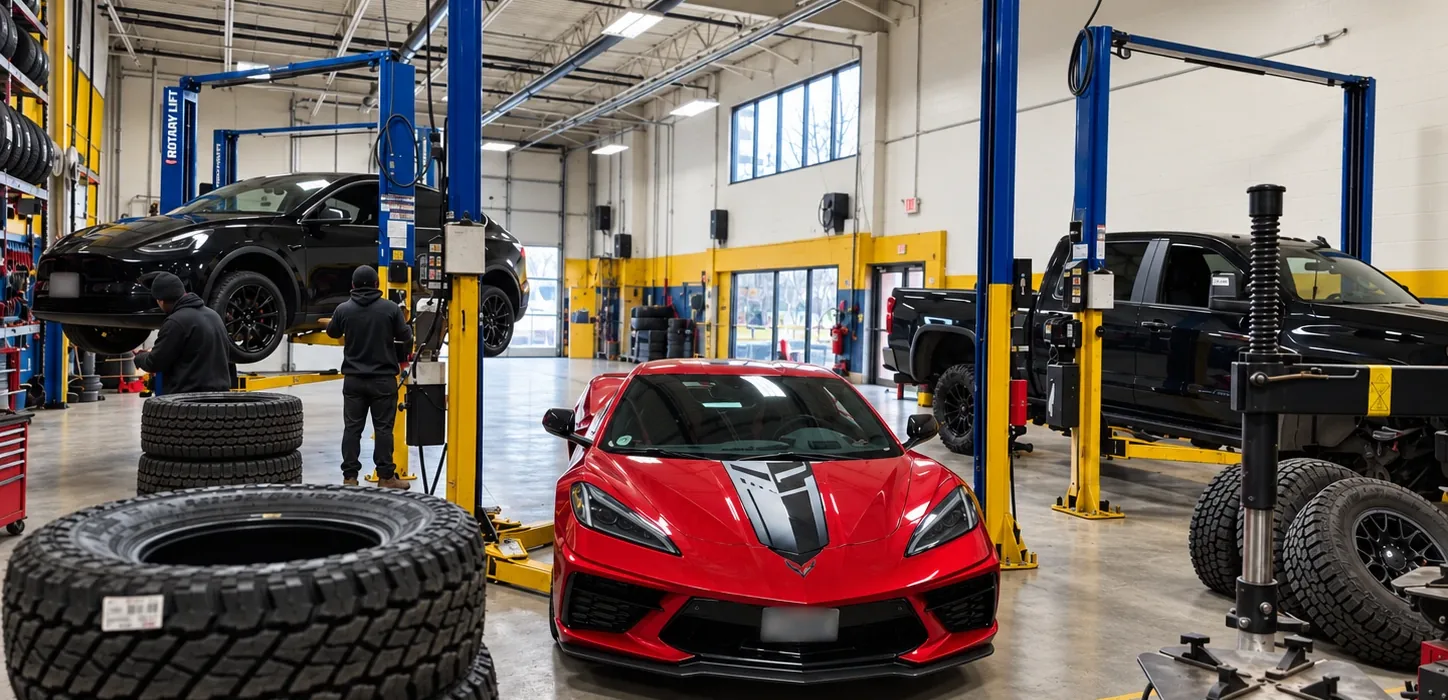
Many Corvette applications use very large, low-profile run-flat tires with extremely stiff sidewalls.
They are among the more difficult passenger tires to mount and require additional care to avoid damaging the tire or wheel.
Not always, but it may be recommended.
If one tire is badly worn or damaged and the tire on the same axle has significantly more wear, replacing both may provide more balanced traction and handling.
The tires with the better traction should generally be installed on the rear axle.
This helps reduce the chance of the rear of the vehicle losing traction in wet or slippery conditions.
Yes.
Before installation, we verify that the tire size and application are appropriate for the vehicle. We also check for obvious clearance, load and fitment concerns.
Old tires are recycled through Ontario’s tire recycling system.
You do not need to take them with you unless you specifically want to keep them.
New tires can feel different because they have full tread depth, fresh rubber and sharper tread blocks compared with the worn tires they replaced.
Steering response, road feel and noise may change slightly until you get used to them.
Possibly.
Used tires need to be inspected for tread depth, age, cracking, repairs, bead damage and other safety concerns before installation.
We will not install a tire that is unsafe or unsuitable for the vehicle.
Yes.
We can install tires purchased elsewhere as long as they are the correct size, load rating and type for the vehicle and are suitable for installation.
If we see a fitment or safety issue, we will point it out before proceeding.
Closed now
Brampton ON L6T 5R4